
On Being an Avoidant
Conflict, silence, and the long apprenticeship of learning to speak

There are people who slam doors. There are people who draft the long, clarifying text message. There are people who cry in public and dare you to say something about it.
And then there are people like me, who go quiet.
I have never had a dramatic fight with a friend in my twenty-two years of living. No screaming matches. No friendship breakups conducted over paragraphs of accusation. No plates thrown, literal or metaphorical. I like to think that this is a sign of some sort of maturity that I have come to develop. It has taken me some time to admit that this is only partially true.
If I am honest, my aversion to conflict is not the product of exceptional emotional intelligence.
I learned early that my role was not to intervene, or rather, I found this role comfortable. I had neither the temperament nor the authority. What I had was the ability to withdraw. To retreat to my room. To turn inward. To become very, very quiet.
There is a Korean word—눈치 (nunchi)—that is often translated (arguably, lazily) as “tact” or “social awareness,” though it feels more intricate than that. It is the art of sensing what others feel before they articulate it, of adjusting yourself accordingly. Good nunchi is praised. It signals refinement, maturity, proper upbringing. A daughter with good nunchi knows when to speak and when not to. More often, she knows when not to.

I came to develop good nunchi (if I do say so myself). I could tell when my mother’s silence meant exhaustion rather than anger. I could tell when my father’s frustration was not about the immediate inconvenience but about something older, something he could not quite name in English. I adjusted. I made myself smaller when necessary. I did not insist. I did not demand.
In an immigrant household, harmony is not merely sentimental. It is infrastructural. There are already too many external pressures—work, money, language, the daily negotiation of belonging. Why introduce more friction? I internalized, without anyone stating it explicitly, that my job was to preserve equilibrium. If something hurt me, I could handle it privately. If I disagreed, I could reframe it. If I was angry, I could analyze it.
Avoidance did not feel like cowardice. It felt like contribution.
And so I became the girl who did not fight.
When someone disappointed me, I did not say so. I conducted a quiet inquest instead. I replayed the conversation, assigned motives, constructed alternate outcomes. I told myself that confrontation was unnecessary, even vulgar. Why rupture something that could be endured? Why introduce volatility when patience would suffice?
But over time, I began to notice how much labor this required. The effort of translating anger into composure. The effort of convincing myself that what bothered me did not matter. The effort of appearing easy. Feelings sediment when they are not aired. You can preserve the surface of harmony while something heavy settles underneath. You can be praised for your calm and still feel curiously unseen.
As I moved into adulthood—into offices, into professional spaces where I introduced myself with practiced confidence—I saw how this training traveled with me. I am good in meetings. I read hierarchies quickly. I know when to wait and when to interject. I can sense when an idea will land and when it will be politely ignored. This, too, is nunchi, transposed into adulthood.
But there is a thin line between composure and erasure.
If you are too adept at adjusting, you risk becoming ambient. I have swallowed objections because I did not want to seem difficult. I have softened my language until it barely resembled my original thought. In a Korean immigrant household, humility is virtuous. In an American workplace, humility can look like uncertainty. I stand between these value systems, translating myself in both directions, never entirely sure which register is correct.
In Defense of Avoidant Tendencies (Partially)
And yet I do not want to discard what avoidance has given me. It has made me observant. It has made me patient. It has taught me to sit with discomfort instead of flinging it outward. I am slow to anger and, perhaps more importantly, slow to condemn. I do not sever relationships easily. I can tolerate ambiguity. I can see how someone might have arrived at a position without immediately deciding that they are malicious.
There is a steadiness in this. A refusal to be ruled by the loudest emotion in the room.
The problem is not that I learned silence. The problem is that I learned almost nothing else.
(Un)learning
I am twenty-two now, and I find myself rehearsing new scripts. Not explosive ones. Not the kind that involve slamming doors. Smaller sentences. Clearer ones. “That hurt me.” “I disagree.” “I need more from this.” They feel disproportionate in my mouth, as if I am testing machinery that has rusted from disuse.
To speak up is not merely to risk conflict. It is to risk altering how I am perceived. The agreeable daughter. The easy friend. The composed young professional. Who am I if I am no longer seamless?
I think often about that child in the hallway, listening to the quickened Korean in the kitchen. She was not weak. She was adaptive. She cultivated the skills available to her. She learned to read the weather and survive it. I do not resent her silence. It kept the peace she knew how to keep.

But I am no longer confined to that hallway.
If avoidance was once a shield, perhaps it can now be a pause—a moment of consideration before speech, not a refusal of speech altogether. I want to retain my nunchi, but not let it dictate my disappearance. I want harmony, yes, but not the kind built on my erasure. I am beginning to suspect that real maturity is not the absence of conflict but the willingness to enter it deliberately, with the same attentiveness I once reserved only for retreat.
An Avoidant Magical Girl?
Recently, I read A Magical Girl Retires by Park Seolyeon, translated by Anton Hur, and I found myself unexpectedly indicted by it. The novel opens with a millennial woman—twenty-nine, unemployed after the pandemic, buried in credit card debt—standing on Seoul’s Mapo Bridge, prepared to end her life. It is not melodrama that brings her there but exhaustion: the dull humiliation of financial precarity, the feeling of being surplus to the world’s requirements. She is interrupted, of course, by a girl dressed in white—Ah Roa, a clairvoyant magical girl who believes our narrator might be the greatest magical girl of all time. The premise is absurd and luminous at once. Imagine discovering, at the moment you have decided you are most disposable, that you might in fact be chosen.
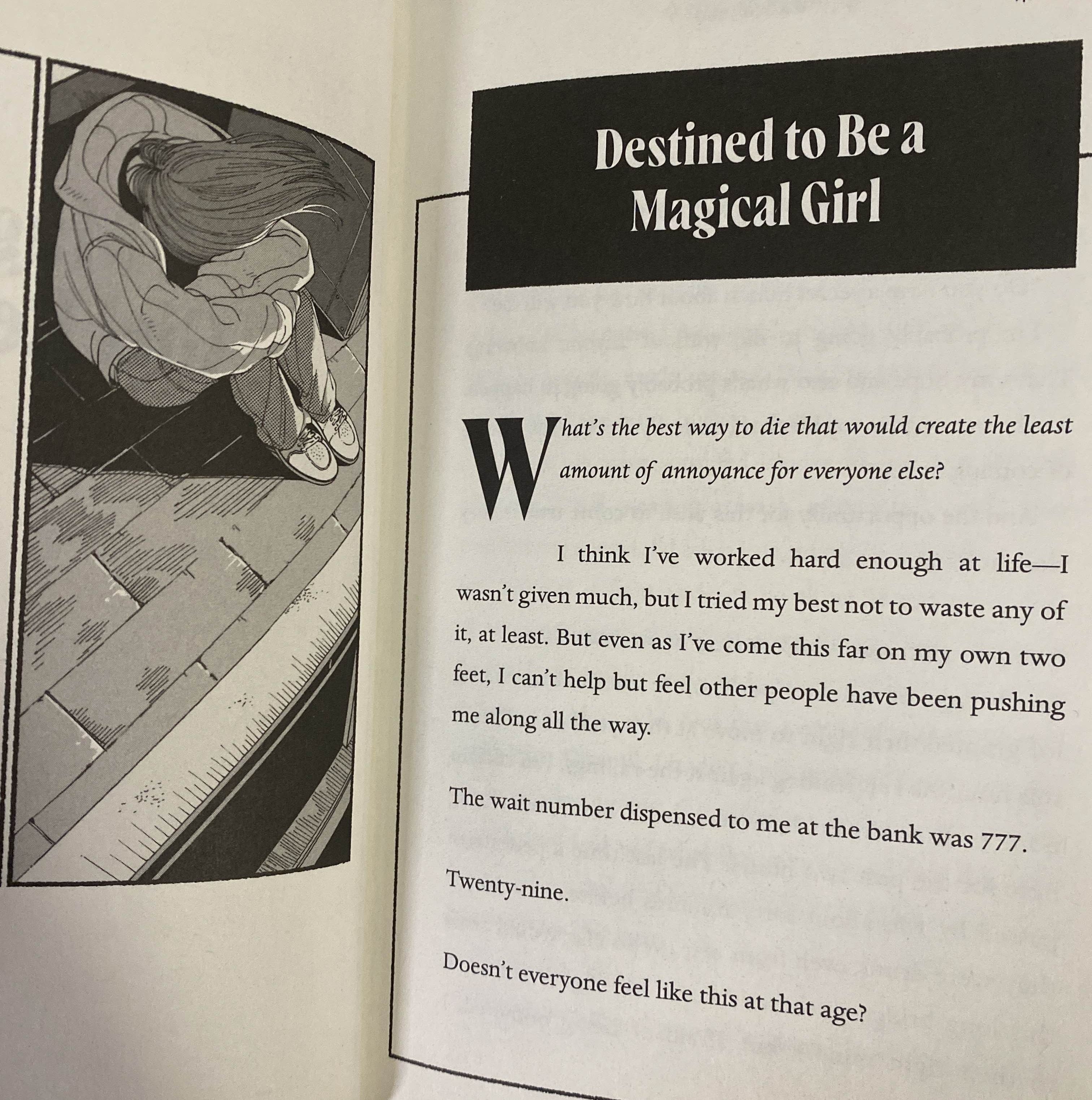
SPOILER ALERT:
What struck me was not the twist itself—that she is not, in fact, the magical girl everyone is looking for—but the humbling embedded in that realization. To believe, even briefly, that you might be chosen, only to discover that you are not, feels worse than never having hoped at all. It is one thing to accept your ordinariness; it is another to be told that you almost mattered. The novel lingers in that space of deflation. It refuses the consolations of destiny. It asks what remains when you are not exceptional.
Reading it, I recognized something uncomfortably familiar. Avoidance, too, is bound up with a fantasy of specialness. I told myself I was mature. I was not loud, not volatile, not needy. I was, in my own narrative, the composed one. The girl of restraint. But beneath that composure was a more fragile belief: that being agreeable would secure my place in the story. That if I did not disrupt, I would be indispensable. That goodness—defined as seamlessness—would guarantee belonging.
The protagonist of A Magical Girl Retires must confront the fact that she is not the chosen savior. She is not even particularly good at being extraordinary. And yet the novel does not end in annihilation. It pivots, subtly, toward something less glamorous and more difficult: the possibility that meaning does not arrive through spectacle. It may arrive through minor, uncelebrated acts. Through persistence. Through staying.
There is something bracing about this refusal of grand transformation. The book does not grant her the glittering wand. It does not reward her with cosmic affirmation. Instead, it invites her to reconsider what it means to exist without being exceptional. To exist without being perfectly legible. To exist without vanishing.
I think, now, that my own development resembles this quieter arc. I am not transforming into someone dazzlingly confrontational, someone who commands every room. I am not shedding my past self in a blaze of revelation. I am learning something smaller and more humbling: that I do not need to be the perfect daughter, the seamless colleague, the endlessly agreeable friend in order to deserve space. I do not need to be magical. I need to be present.
If the narrator of Park’s novel must relinquish the fantasy of being chosen, I must relinquish the fantasy that silence alone makes me virtuous. Both fantasies are forms of escape. One imagines salvation through spectacle; the other imagines safety through disappearance. What remains, in both cases, is the harder work of ordinary courage.
Perhaps this is the real coming-of-age story—not the discovery of hidden powers, but the acceptance that you are neither savior nor specter. That you are simply here. And that being here, fully, audibly, imperfectly, is enough.
i am so glad this found me! you articulated this so eloquently in a way that makes me feel seen so tenderly. it's nice to know that this internal turmoil isn’t a lone experience. thank you for sharing. may we all be braver and kinder to ourselves.
thank you for articulating this thought so well. i neeeded it. is 22 the year that all the avoidant gals shed the habits that no longer serve them?!?!?! i hope it is